
Every helicopter pilot has heard the term vortex ring state. It appears in flight manuals, training syllabi, accident reports, and countless online discussions. Yet despite its reputation, it remains one of the most misunderstood aerodynamic phenomena in rotary-wing aviation.
Part of the confusion comes from the name itself. “Settling with power” sounds dramatic. Videos on social media often portray it as an invisible force that suddenly pulls a helicopter out of the sky with no chance of recovery. Reality is more nuanced. Vortex ring state (VRS) is a well-understood aerodynamic condition, and when recognized early, it is normally recoverable.
The challenge isn’t memorizing a definition. It’s recognizing the cues before they become severe—and understanding why the helicopter behaves the way it does.
What Actually Happens?
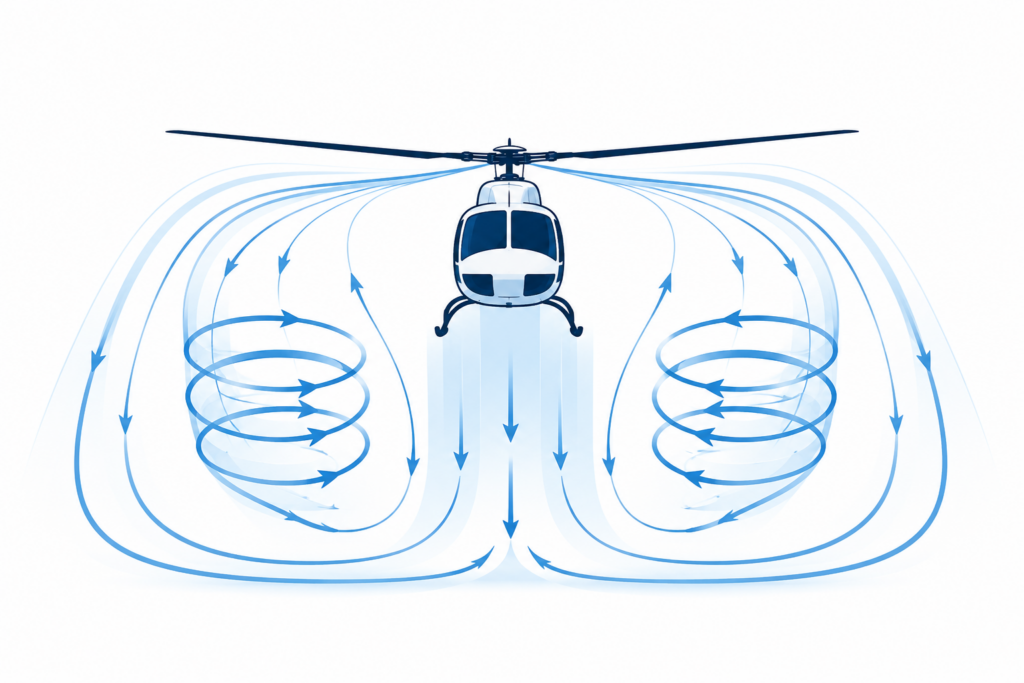
In a hover, the rotor continuously accelerates air downward to produce lift. Under normal forward flight, that disturbed air is left behind as the helicopter moves away.
During a steep descent with relatively low forward airspeed while still using significant power, the situation changes. Instead of descending into clean air, the rotor begins to descend into its own turbulent wake.
The airflow through the rotor disc becomes highly disturbed. Large rotating vortices form around portions of the rotor system, reducing the rotor’s efficiency. The pilot may instinctively pull more collective to stop the descent, but this often makes the condition worse by strengthening the recirculating airflow.
Contrary to popular belief, the rotor has not “stopped producing lift.” Parts of the disc continue to generate lift, but the airflow has become so disrupted that the helicopter can no longer maintain controlled performance as expected.
The Conditions That Increase the Risk
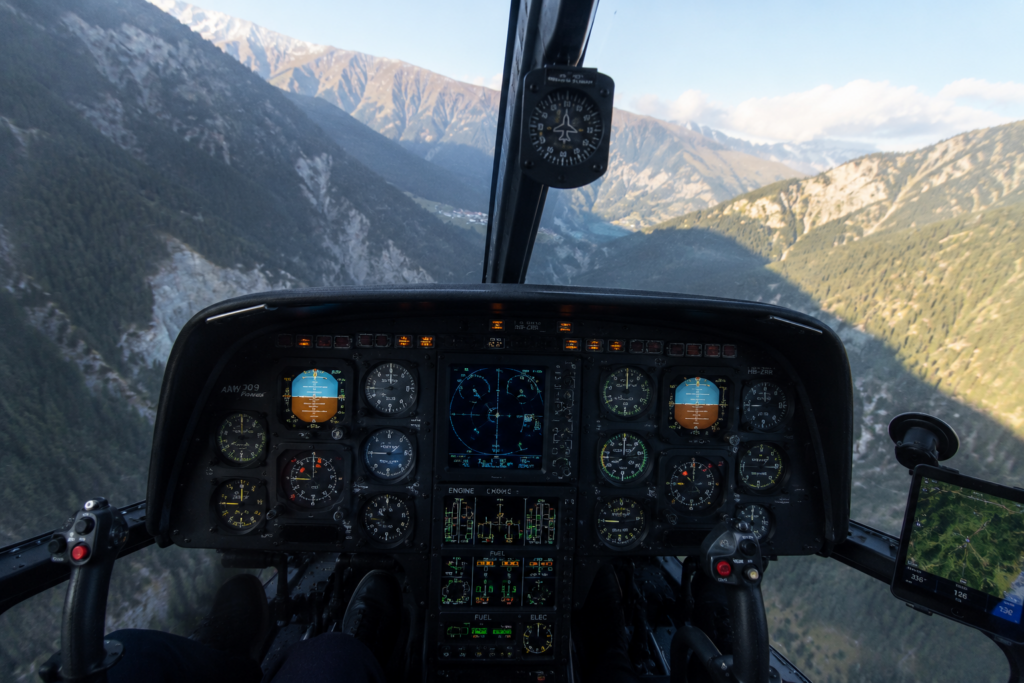
Altough every helicopter type has its own flight manual limitations, vortex ring state generally requires several factors to occur together.
Typically, pilots are looking at:
- Low forward airspeed.
- A relatively high rate of descent.
- Significant engine power already applied.
- Descending into relatively undisturbed air rather than through translational airflow.
This is why VRS is most often associated with steep approaches, confined area operations, pinnacle landings, or vertical descents where pilots attempt to hold altitude with increasing collective.
It’s worth emphasizing that simply descending vertically does not automatically produce vortex ring state. Likewise, a high descent rate alone is insufficient. The aerodynamic combination matters.
What Does It Feel Like?
One of the reasons VRS catches pilots off guard is that the first signs can be surprisingly subtle.
Pilots commonly report:
- Increasing vibration.
- An unexpected sink rate.
- Reduced control effectiveness.
- The need for excessive collective without the expected response.
The helicopter often feels “mushy.” Instead of responding crisply, it continues descending despite additional power.
The natural human reaction is obvious: pull more collective.
Aerodynamically, that’s usually the opposite of what the rotor needs.
Recovery Is About Escaping the Disturbed Air
The goal is simple: move the rotor system back into clean airflow.
Training methods vary slightly between manufacturers, but the underlying principle remains remarkably consistent.
Recovery generally involves reducing the conditions that created the vortex ring state by lowering collective as required and introducing forward or lateral cyclic to fly out of the disturbed air. Once clean airflow is re-established, power can be increased again as needed.
Some helicopter manufacturers publish specific recovery techniques in their Rotorcraft Flight Manuals, and these procedures should always take priority over any generic advice.
For pilots flying helicopters equipped with advanced stability augmentation or sophisticated autopilot systems, recovery procedures remain fundamentally aerodynamic. Automation may assist with aircraft handling, but it cannot change the physics occurring at the rotor disc.
Why Flight Simulators Are Surprisingly Useful
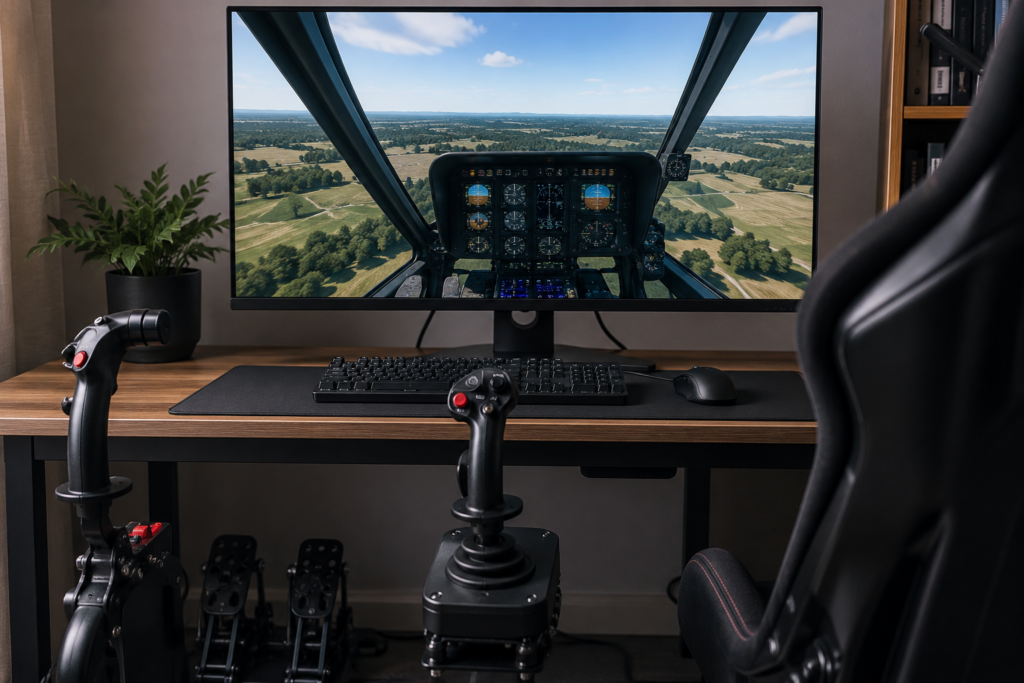
For obvious reasons, nobody wants to experience a genuine vortex ring state for the first time close to the ground.
This is where modern flight simulation becomes genuinely valuable.
Today’s helicopter flight models—particularly those that implement blade element physics rather than simplified lookup tables—can reproduce many of the cues associated with VRS. While no desktop simulator perfectly recreates the physical sensations, they can teach recognition, timing and decision-making remarkably well.
The biggest advantage isn’t learning the recovery itself.
It’s learning to recognize the situation before it develops fully.
That kind of pattern recognition transfers surprisingly well into real-world flying.
A Safe Way to Practice in a Simulator
One mistake many new simulator pilots make is trying to induce vortex ring state a few metres above the runway.
That teaches very little.
Instead, climb to a comfortable altitude with plenty of recovery margin. Several hundred feet above ground provides time to observe the aircraft without feeling rushed.
Establish a stabilized hover or slow flight, then carefully enter a powered descent while maintaining low forward speed. Watch how the helicopter responds rather than forcing the aircraft into an extreme condition.
If vibration increases or the sink rate suddenly accelerates despite additional collective, begin the recovery immediately.
Don’t keep pulling collective simply to see what happens.
The objective isn’t crashing.
It’s learning the sequence of events that leads to the condition.
Reset, climb again, and repeat.
Several short practice sessions are far more valuable than one dramatic experiment.
Not Every Simulator Models It Equally
One important limitation deserves mentioning.
Not every helicopter add-on models vortex ring state with the same fidelity.
Some aircraft feature detailed aerodynamic simulations that include realistic induced-flow behaviour. Others implement simplified approximations—or no meaningful VRS modelling at all.
As a result, pilots shouldn’t assume that every helicopter in every simulator behaves like the real aircraft.
This isn’t necessarily a flaw. Desktop simulators are designed for entertainment, procedural training and skill development—not certification.
The goal is understanding the aerodynamic concepts rather than chasing identical behaviour across every virtual helicopter.
Why VRS Still Appears in Accident Reports
Despite decades of pilot training, vortex ring state continues to appear in accident investigations around the world.
Interestingly, the aerodynamic phenomenon itself is often only part of the story.
Many accidents begin with something much more familiar:
- An unstable approach.
- Pressure to land.
- Loss of situational awareness.
- Misjudging wind conditions.
- Continuing an approach after recognizing that something feels wrong.
By the time vortex ring state develops, several earlier opportunities to abandon the approach may already have passed.
That’s one reason instructors place such strong emphasis on stabilized approaches and go-around decisions rather than simply teaching the recovery manoeuvre.
Avoiding VRS is almost always easier than recovering from it.
The Takeaway
Vortex ring state has earned a reputation as one of helicopter aviation’s most intimidating aerodynamic phenomena. In reality, it’s neither mysterious nor unavoidable.
It develops under identifiable conditions, produces recognizable warning signs, and has well-established recovery techniques published by manufacturers and taught during helicopter training.
Modern flight simulators won’t replace real instruction, but they offer something remarkably useful: the chance to experience the onset of VRS repeatedly, without risk, until recognizing the warning signs becomes instinctive.
And perhaps that’s the most valuable lesson of all.
The best helicopter pilots aren’t the ones who master spectacular recoveries.
They’re the ones who recognize the situation early enough that they rarely need one.